
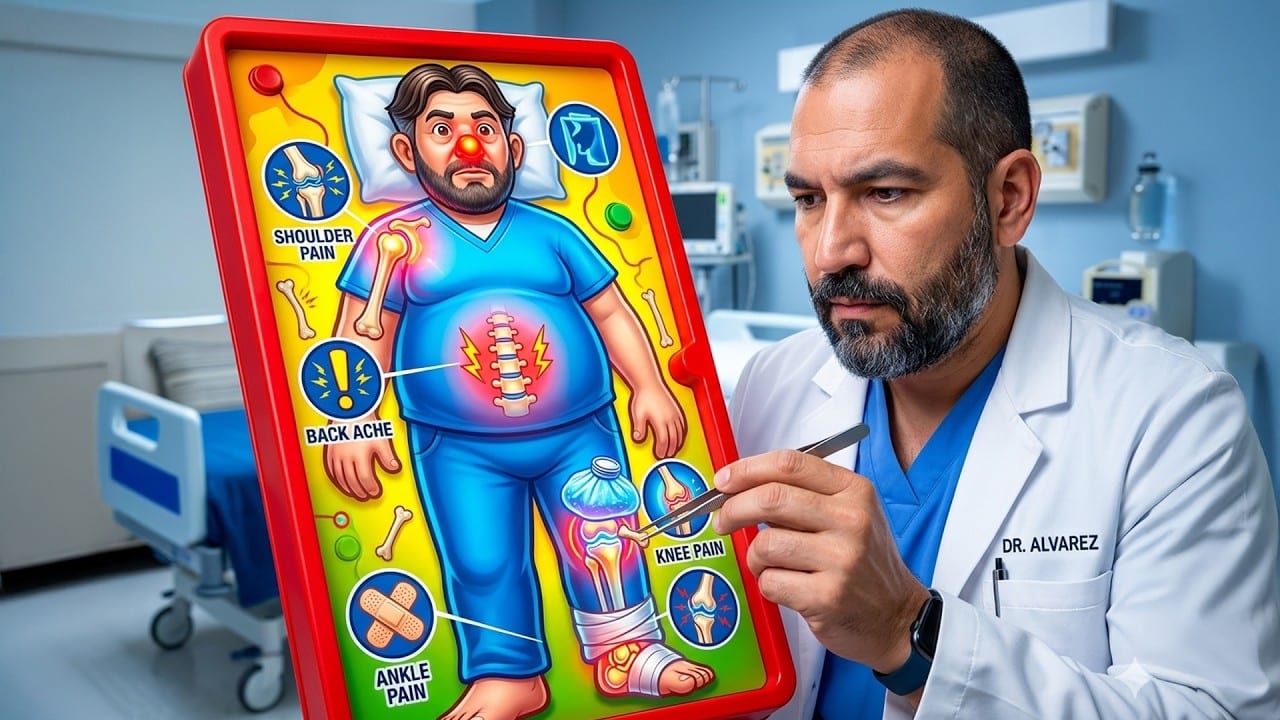
If you are living with chronic joint pain, you know that it isn’t just a “minor ache.” It is a constant shadow over your daily life. Whether it’s your knees, your hips, or your lower back, that persistent pain dictates how far you can walk, how long you can stand, and even how well you sleep at night.
As a bariatric surgeon, one of the most common questions I hear is: “Dr. Alvarez, will a gastric sleeve actually fix my joint pain?”
The answer is a resounding yes, but perhaps not in the way you might expect. Let’s dive into the science of why your joints are hurting and how weight loss surgery changes the equation.
The Heavy Burden: It’s a Numbers Game
To understand why your joints hurt, we have to look at the mechanical stress of excess weight. Your knees, in particular, are remarkable shock absorbers, but they have their limits.
For every single pound of extra body weight you carry, your knees experience three to four times that load during normal movement. To put that into perspective, if you are carrying an extra 50 pounds, your knees are actually feeling an additional 150 to 200 pounds of pressure with every step you take. Over years and decades, this constant pounding accelerates the wear and tear on your cartilage, leading to a condition we call Osteoarthritis.
Beyond the Pressure: The “Silent” Factor
While the physical weight is a major culprit, it isn’t the only one. Many people don’t realize that excess fat tissue is biologically active. It releases inflammatory signals throughout your entire body.
This means you are fighting a two-front war:
– Mechanical Stress: The physical weight crushing the joint.
– Systemic Inflammation: Chemical signals making those joints feel stiffer and more painful.
How the Gastric Sleeve Changes Everything
When my patients undergo gastric sleeve surgery and begin their weight loss journey, they often report a “lightness” they haven’t felt in years. This happens because the surgery addresses both of those “war fronts” simultaneously.
First, the mechanical load is lifted. As the pounds drop, the exponential pressure on your knees and hips vanishes. Walking becomes a joy rather than a chore. Second, as you lose fat tissue, those inflammatory markers in your body decrease. This often results in less stiffness and a significant improvement in overall mobility.
A Dose of Reality: Is it a Cure?
I always want to be honest with my patients: The gastric sleeve does not “cure” osteoarthritis. If the cartilage in your joint has already worn away, the surgery cannot magically regrow it.
However, what the surgery does do is slow the progression of the damage significantly. By removing the crushing weight and the inflammation, we stop the “downward spiral.” For many, this means avoiding or delaying major orthopedic surgeries, like knee or hip replacements, for years or even decades.
The “Golden Window” for Your Joints
The best results are seen when we catch the problem early. Patients in the early to moderate stages of joint pain often see the most dramatic improvements in their quality of life.
Once you lose the weight, movement becomes easier. This is the “secret sauce” to long-term success. When it hurts less to move, you can finally start exercising to strengthen the muscles around your joints, which provides even more stability and further reduces pain.
Joint pain is more than just a symptom; it’s a limitation that keeps you from playing with your grandkids, traveling, or simply enjoying a walk in the park. While the gastric sleeve isn’t a “joint repair” surgery, it is a powerful tool to take the burden off your body so you can start living again.
Are you ready to take the weight off your joints and get back to the life you deserve?
If you want to know whether you qualify for gastric sleeve surgery, start with our quick twenty five second quiz. It is the first step toward your new life.